

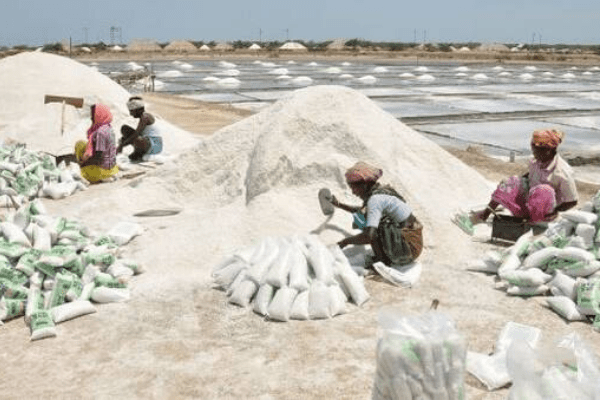
Although salt was widely produced throughout Nigeria, there was frequently a shortage due to the strong demand for it. Salt was made by boiling or evaporating brine spring and lake water, seawater, or vegetable ash. The people that produced sea salt were Nembe, Ijo, and Itsekiri. While there were numerous salt springs and marshes in the Jukun area, salt was worked at Awe in Adamawa. Despite their gray hue, the brine lakes of Okposi Uburu and Abaliki, as well as the salt extracted from them, were regarded as having very delicious flavor. Additionally, Borno and Ogoja produced salt. Together with salt produced locally, salt was also imported, initially via the Sahara in the north and then via the ocean in the south.
Barth calculated that roughly 3000 camel loads of salt per year from the desert town of Bilma entered Hausaland during the 19th century. Nigeria began importing European salt in the fifteenth century to augment the indigenous supply.
In actuality, the effects of imported salt were not apparent until the late 19th century. The irony is that during the colonial era, local salt production steadily decreased, much like the iron-smelting sector. Nonetheless, they were brought back to life twice: once during the Nigerian Civil War and again more recently with the government’s efforts to support the country’s industrial sector. The majority of the time, women produced salt, and it was typically associated with taboos and rituals .In pre-colonial times, salt was not only a valuable commodity in trade but also a form of money. However, salt has the drawback of becoming too moist to eat. In the age of the Atlantic slave trade. Although a lot of salt was transported to Bonny, Warri, Benin, and Calabar, the indigenous salt outperformed it.
More on salt production.
CLOTH INDUSTRY
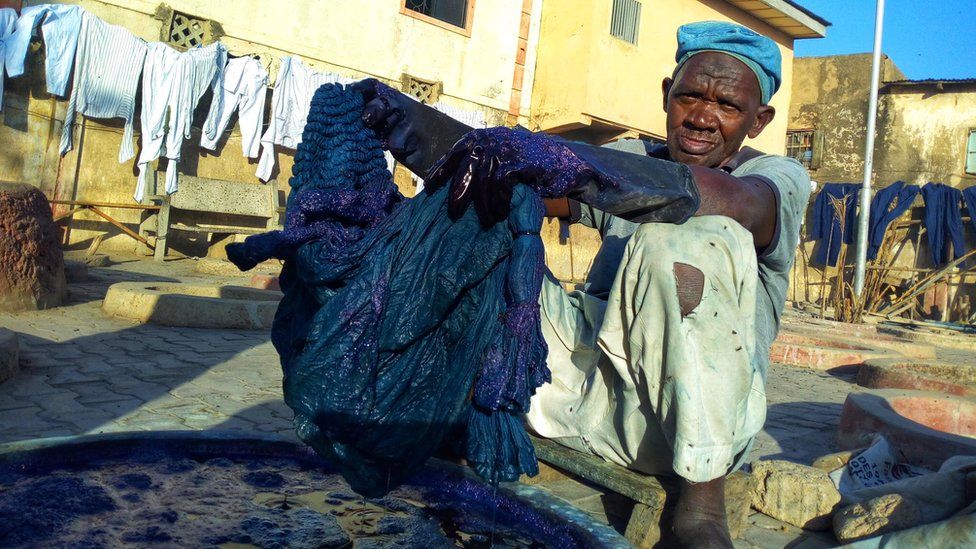
The oldest textiles were produced from raffia, or palm leaves, and plants like aji in Igboland. However, cotton that was cultivated nearby eventually became the main ingredient in clothing. Without a doubt, Nigeria has a long history of producing textiles. Cotton was already being produced by the 19th century A.D., according to excavations at Igbo-Ukwu. Cotton played a significant role in trans-Saharan trade, and beginning in the sixteenth century, Nigerian textile was transported outside. It has been proposed that the introduction of Islam to the Northern Nigeria region some ten centuries ago must have resulted in a rise in the market for cotton textiles.
The old informal attire was eventually replaced with flowing garments and headgear with the introduction of Islam. The three processes of spinning, weaving, and dying were used to make cloth. Because each operation required a particular skill set, it formed its own industry. Important industries in Kano, Sokot, Bida, Ilorin, Oyo, Abeokuta, Iseyin, Akwete, Okene, and the Itsekiri region included spinning yarn, weaving, and dyeing. People in each location had a favorite type of cloth that was specific to that area, with unique dimensions, colors, and designs.While both genders worked in spinning, weaving, and dying in Yorubaland and Northern Nigeria, these crafts were typically performed by women. In yorubaland, the difference was that whereas the males used narrow looms, women utilized wider ones.
Almost every piece of equipment used for spinning and weaving was built locally of wool. Local smiths also created the iron bars used to wind the final strips of cloth and the iron rods used as pedals on the looms. Even the dyes, which could primarily generate green and blue colors, were of excellent quality and were made locally. Plants like indigo and camwood were used to make the dyes. Kano was known as the Manchester of west Africa because it was the most significant center for the production of textiles in both Nigeria and West Africa.
Kano and the surrounding towns and villages were full of dye-pits. Throughout the central and western Sudan, as well as in parts of North Africa, there was a high demand for locally woven, lustrous, navy blue Kano fabric. Barth notes accurately that the exquisite cotton fabric that previous explorers had extolled in Timbuktu was imported from Kano rather than produced locally.
He also notes that traders had to transport their fabric as far north as Ghat and Ghadames during the Kebbi Revolt, when the straight route to the western Sudan was blocked, and then return to Timbuktu for distribution in the south. It is said that when Kano fabric was dyed and embroidered, there was a greater market for it. Because Kano artisans were so proficient, a re-export industry emerged. After being brought over the Sahara, coarse European or calico was colored and ready for the African market. After that, the fabric was shipped again, this time to North Africa and another region of West Africa. Kano also exported textiles made in other Hausaland regions. Bida held significance in the textile sector as well. They also made women’s wrappers and men’s gowns, both of which were in great demand.
Cotton fabric was produced and exported by the Jukun and the Kanuri of Borno. The Tiv tied a thin strip of coarsely woven white cloth together after weaving it. Yorubaland created specialized centers for the production of the high cloth. Before it was destroyed, Old Oyo served as the cotton industry’s hub. During the 1800s. After then, Ibadan became the primary location for the production of adire and aso oke, the Yoruba blue fabric. From the 17th century, the ijebu produced strong, high-quality cloth that was exported to Benin and purchased by Europeans.
Then, the Europeans sold the fabric in Angola, Gabon, the Gold Coast, and eventually Brazil. Additionally, Benin developed its own cotton fabric for export or domestic use. Cotton textile was crafted in Igboland by the Elugwu people, Akwete women, and the Igbo from west Niger. Because of its distinctiveness based on color and design, akwete cloth has continued to be popular and distinctive. It is currently recognized as an Igbo cultural icon.

Leave a Reply