


The major hubs for the leather and skin industries were and still are Sokoto, Kano, Bida, and Maiduguri. Similar to the textile industry, Kano’s importance stemmed from its status as a commercial hub, which attracted a large volume of goods from surrounding regions for sale or export. Furthermore, the city has emerged as the hub for the real manufacture of leather goods in recent years. Saddles, harnesses, shoes, slippers, leather outfits, bags, and cushions are among the items made.
Skins of goats, sheep, snakes, and lizards were frequently used. Tannins were used in the production of leather. The animal’s skin was first stretched, smoothed, and sun-dried. The skin was bathed for a few days and treated with certain locally made chemicals. Lime and wood ash were used in Hausaland to whiten leather. Leathers were occasionally colored. After that, it was dried to give it the necessary thickness and texture. The red goats of Sokoto created a special kind of silky leather. Sokoto leather and other leather goods are said to have been exported to North Africa via Agades, Tuat, and Fez throughout the Middle Ages, and then to other Moroccan ports.
The soft leather was exported from Morocco to Europe, where it was mistakenly referred to as Moroccan country leather because it had passed through Morocco. Leather products from the grasslands were virtually the only source of income for the southern region of Nigeria. Nonetheless, as a display of the hunters’ skill, the skins of wild creatures killed in the south, such lions and leopards, were flayed and put on display in their homes.
OTHER INDIGENOUS INDUSTRIES.
Carving
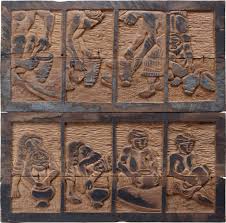
Fine firm wood from Nigeria’s southern woods encouraged woodcarving. Similar to ceramics, carved items were made in numerous villages. Sacred statues, stools, doors, and wooden utensils including spoons, ladles, bowls, mortars, and pestles were among them. A few of the carved items, including as heads and figures, were on display in shrines or royal palaces. Some items, like masks, were employed for amusement as well. The Cross River State’s Oron Museum is home to over 600 Ekpu, or wooden figures. The Umudioka of Akwa set themselves apart from other Igbo people as skilled carvers. They held the opinion that, while it could be learnt with a lot of effort, woodcarving was primarily a hereditary talent.
The Nupe made hardwood stools and ornamented mortar, while the Jukun were experts at making masks. Ivory carving was a notable skill of Benin. As the FESTAC insignia, one of its ivory masks has gained notoriety. As was previously mentioned, a large number of these ivory carvings were taken by the British during their invasion of the town in 1897 and are now housed in museums around Europe.
Gourds were used to create exquisitely carved calabash decorations. There were calabash decorators in Kano, Borno, and Oyo. The Nupe made hardwood stools and ornamented mortar, while the Jukun were experts at making masks. Ivory carving was a notable skill of Benin. According to the FESTAC insignia, one of its ivory masks has gained notoriety. As was previously mentioned, a large number of these ivory carvings were taken by the British during their invasion of the town in 1897 and are now housed in museums around Europe. Gourds were used to create exquisitely carved calabash decorations. There were calabash decorators in Kano, Borno, and Oyo. A portion of the calabashes were utilized as containers or for ceremonial purposes. The Fulani women possessed a variety of calabashes for both domestic usage and selling fresh milk.
There is ample evidence of jewelry use throughout Nigeria’s many cultures. There is evidence of beads at the sites of Nok, Ife, Igbo Ukwu, and Benin. The glass industry of the Nupe was well-known for using gemstones to create beads. Broken bottles were used to create the glass beads. The hub of this industry was Bida. Bida’s significance in the fields of bronze work, weaving, dyeing, leatherworking, grass weaving, hand embroidery, and brasswork has already been discussed. Put another way, akori beads, whose exact origins are unknown, were a significant component of Nupe jewelry. Brewing was an industry involved in food processing.
In Hausaland, beer was made from milet and corn, and in Yorubaland, from plantains and bananas. Particularly in the southern forest region, oil and raffia palm trees were used to harvest palm wine. Additionally, a kind of wine was made from kolanuts.
In many societies, ash and palm kernel oil were combined to make black soap. Particularly among the Yoruba and Igbo, this soap is thought to have great therapeutic efficacy.
In the riverine regions, canoe construction took place. Tsoede, the greatest monarch of the Nupe, was credited with teaching them how to make enormous canoes and improving their techniques for blacksmithing and coper-making. Large, enormous canoes were constructed as early as 1500 A.D. by the bright people of the Niger Delta. With the use of the boats, they were able to trade salt and fish for yams, cows, goats, sheep, and slaves from the interior.
Grass weaving: Grass weaving originated in the northern grasslands with various savannah and palm tree species. The Nupe and Gawai were among the most skilled of these grass-weavers. Their men weave grass mats, which are widely used to decorate homes, in a variety of colors, forms, and sizes. They were also very useful to the people since they made weaved caps, containers, screens, and fences. Large quantities of raffia mats and bags are made by the Ibibio of the state of Awka, Ibom. They also use canes and palm fronds to build baskets.
A key part of Nigeria’s domestic economy was its industries. Some people worked full-time at their skill, while others only worked on it part-time in the evenings after the workday was over. However, it would seem that during the dry season, when farm work was less demanding or involving, industrial operations peaked. The majority of artisans owned farms where they raised food crops, and some even went so far as to sell their own handmade goods.
It’s difficult to pinpoint the exact beginning of industry in the Nigerian region. Undoubtedly, many of them are very old, and while the significance of some has decreased, that of others has not decreased. Nigeria’s indigenous industries are distributed in a way that indicates most villages have at least one specialized specialty. Thus far, our research has demonstrated the significance of Bida and Kano as hubs for several businesses. Oral tradition, visits by Arab and European travelers, and the industries that are still in operation have all contributed to shedding more light on Nigeria’s past. Nigeria’s history has benefited greatly from the centuries-long existence of indigenous industry.
It first demonstrates the interdependence between the forest and sudan zones, which in turn promoted the flow of products, people, and ideas from east to west and vice versa. Second, the outputs of these businesses have provided us with an understanding of the type and extent of interaction that existed among the peoples of Nigeria, which further bolsters the case for the pre-existing unity among the people of the Nigeria region prior to the arrival of Europeans and the 1914 amalgamation. More precisely, the practice of bronze sculpting across the nation has contributed to the legitimacy of the oral tradition that holds Ife central to the dissemination of concepts and methods to Benin and a portion of the Niger-Benue valley. There is now evidence to imply that Owo served as a go-between in this process between Ife and Benin.
Pottery, stone, and iron tools found in some archeological sites demonstrate that Nigerians went through different developmental stages from gathering to producing food to the Iron Age, just like other people.Stated differently, the economy was dynamic rather than static, as certain authors from the past would have us think. Nigerian communities also engaged in trade, which resulted from the fact that, depending on the raw materials available, different villages specialized in different trades. Trade, whether local or long-distance, predated the arrival of the white man. The breadth and diversity of products traded were expanded by Europeans and Arabs. A hitherto overlooked aspect of Nigerian history has come to light through the study of indigenous enterprises.
Political history has often been overshadowed by the study of spectacular events like wars and the lives of famous leaders. Through researching indigenous industries, we are better able to understand the role and significance of the common people who, by supporting various governments with their strong economic foundation—sometimes through their crafts—also contributed to the rise to prominence of notable individuals. Nigeria’s unique identity is influenced by its local industries, which involve skilled craftsmen producing bronze heads, textiles, and leather items. Many of these might be seen on display at museums both in Nigeria and in Europe. The belief is that some industries, despite the impact of modern manufacturing, may continue to thrive with minor adaptations for decades to come.

Leave a Reply