

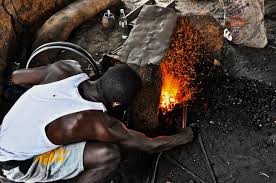
Iron smelting industries: long before the ninth and tenth centuries, Nigerian iron smiths worked with copper, tin, and iron. Iron was the most significant of these metals and it was found in many places.
Historians and archaeologists agree that iron technology—that is, ore mining, smelting, and smithing—is a turning point in precolonial African history. Iron-made implements such as hoes, knives, spears, and swords were more advantageous than their wooden or stone counterparts. Second, the invention of iron tools allowed man to exert more control over his surroundings. Thirdly, the use of iron increased agricultural productivity since it made implements made of iron better suited for clearing brush and tilling land than stone ones. Consequently, food became more plentiful. Iron weapons, on the other hand, were more lethal. It’s thought that iron tools and weaponry became more prevalent.
This clearly demonstrates the strong connection between agricultural, political power, and iron technology. Iron’s significance is further demonstrated by the fact that it is mentioned in many Nigerian societies’ genesis tales or world creation narratives. For instance, Ogun is now recognized as the patron of bikers, drivers, and blacksmiths, although it was once revered in Yorubaland as the god of iron. There are also iron nails embedded in the Oramiyan staff at Ife. Furthermore, according to the Bayagida tale, the Hausa’s patron hero is said to be carrying a mystical knife that was supposedly crafted by the Gaya smiths in Kano. The usage of iron as money is another indication of its significance.
According to professor Elizabeth Isichie, “iron hoes were a currency and thirty were needed for bride- wealth” among the Tarok of the Jos Plateau. Among the Birom of Bukuru, a wealthy individual might be identified by his leg greaves, an iron decoration.
Nigerian iron technology evidence.
Some historians argue that iron technology had to have originated somewhere else in order to reach West Africa because it was a very complex and detailed process. They propose that the information must have originated in the first millennium B.C., either from Meroe, an ancient Nile River culture, or from ancient Carthage via trade across the desert.
It is also the contention of other historians and archaeologists that iron technology originated independently in west Africa. The Nok region of Nigeria has the oldest records of iron smelting. Nok is located close to Abuja, the Federal Capital Territory.
People had mastered working with iron here by 500 B.C., which is earlier than evidence from Meroe or North Africa. Iron axes and spears have been unearthed by archaeologists in Nok, and iron-smelting furnaces have been discovered nearby at Taruga. Beautiful terra-cotta sculptures were also present at these locations. Some archaeologists have hypothesized that ironworking in West Africa was independently invented because of the Nok culture’s antiquity. Additional iron-using artifacts from the second century B.C. have been discovered in the region that the Kanji dam has inundated today. The fifth or sixth century A.D. is the dating of the evidence from Daima in Borno.
Smelting furnaces from the 7th century have been discovered in Kano, and there were specialized iron towns in Oyo. In 1904, one such town had between one hundred and twelve0-people working in the iron smelting and mining industries. Dr. F. Anozie has dug out a significant amount of slag—waste from smelting iron—in the Nsukka region of Igboland. Manufacturing
In the iron sector, specific expertise was required. It was therefore the exclusive domain of a small group. The iron was mined first, and then it was melted. The process of melting iron involves heating iron ore to a very high temperature in a furnace until the iron flows and solidifies.
Smith forged tools and weapons out of smelted iron. They needed hammers, bellows anvils, and furnaces. The bellows, which were either the single bag type or the split-bag type required for hard work, were made of animal skin, while the furnances were made of clay. By pushing the sticks that were fastened on top of each bag alternately, one could physically work the bellows. Through clay tubes, air was transported from the bellows to the furnace. Smelted iron was held over the fire until it become red hot and flexible enough for the blacksmith to pound it into the necessary form on an anvil while charcoal or palm kernel shell burned in the furnace. It’s interesting to observe that most of the time.
The blacksmith made his own hammers, smoothing files, anvils, and whatever other tools he needed. The iron ore was sometimes mined and smelted by the smiths themselves. Rock containing iron was discovered in Sokoto, Katsina, Zaria, and Kano. In addition, a large amount of iron was extracted and smelted in the Mandara mountain region, Nupe, the Jos Plateau, Abriba, Udi, and Nsukka, as well as in several Yoruba communities, most notably Ibadan. Nigerians melted all of the iron they needed before the arrival of the white guy. Iron was brought in from Europe starting in the 17th century to augment that which was produced locally.
The mid-1900s saw a decrease in iron smelting. Smith’s reputation for being in frequent communication with the gods contributed to their high regard in society. What’s more, though, is that they made equipment like spears, arrows, bits and strips for horses, and ornaments for ladies and agriculture. These served a variety of functions, including economic ones. In Nigeria, Ibadan, Ijebu-Ode, Zaria, Bida, Kano, Ilorin, Nkwerre, Awka, and Abriba were home to the top blacksmiths. For instance, Ibadan was referred to as the “city of seventy blacksmiths and sixteen gates.” In the same part of the city, some of these smiths’ descendants still practice their trade today.
However, these days, their primary products are bedheads, frames, and burglary-proof gadgets to meet the needs of the contemporary world. Some to the ones used over a century ago. The Nkwerre smiths learned how to produce firearms in addition to producing tools.
continue

Leave a Reply