

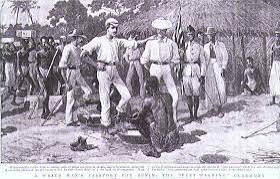
The coastal commerce was initially equitable for all parties. Europeans and Africans. But as time passed, Europeans benefited more from trade, while Africans had fewer opportunities. But starting in the 16th century, the traffic in slaves replaced the interchange of produced goods and raw resources. In the trade, European products like cloths, beads, trinkets, cowrie shells, and hardware are exchanged for African slaves, gold, ivory, pepper, gum Arabic, and ostrich feathers. The coast of West Africa saw the development of numerous port fronts. During the Portuguese era, the ports of Cape Blanco, Cape Verde, and Arguin in Upper Guinea, and Elminah Castle, Sharra, Axim, and Accra in the Gold Coast or Low Guinea region, were all thriving. Others in the Niger-Delta region were Sao Tome, Gwato, Principe, and Fernando Po.
In the interior, trade and missionary endeavors were conducted out of these islands and forts, which were inhabited. In Nigeria, the Portuguese had some degree of success. The intermediaries at the seaside provided them with all the things they required. They were therefore spared from having to travel into the hinterland. Despite attempts to baptize and preach to several African royal families and chiefs, the converts were not given enough instruction prior to baptism.
As a result, the gospel had no long-lasting impact on them. Second, because the Portuguese lacked the manpower needed for missionary work in the interior, Christianity did not take hold at this time. There weren’t many Portuguese missionary teachers because they couldn’t travel in large numbers due to infections and mosquitoes.
REASON FOR THE DECLINE OF PORTUGUESE NIGERIA TRADE.
Portuguese trade with Nigeria was declining by the middle of the 16th century. There are several reasons behind this development. First of all, the deal held no longer a promise. Slaves, pepper, and ivory were no longer obtained in the anticipated great amounts. Second, the Portuguese learned that the Nigerians were only willing to trade them weapons and ammunition in exchange for insufficient native goods. Thirdly, the Portuguese chose to focus their efforts on the more lucrative trade after learning that commodities from Asia were paying more than those from Nigeria.
Fourthly, Portugal lacked the means to use the natural resources of the large territories they controlled. Ultimately, their monopoly was broken by the entry of other European businesses and traders into West Africa. In West Africa, the Portuguese were gradually displaced over time by rivals who were French, Dutch, and English.
RESULT OF THE EARLY EUROPEAN CONTACTS
Early European interactions with Nigeria had a significant impact. First of all, trade between Europeans and Nigerians flourished, greatly benefiting the coastal population. Trade brought products to Nigeria that subsequently evolved into indicators of an individual’s prosperity. Knives, hoes, firearms, gunpowder, beads, glassware, textiles, and other items were among these goods.Second, a lot of individuals from the countryside were drawn to the seaside trade. These made a permanent home with the seaside towns. By moving their administrative centers closer to the coast, numerous inland kingdoms, states, and empires, like Dahomey, attempted to take part in the coastal trade.
Numerous already-existing city states or population centers, like Bonny, Calabar, and others, were also enlarged by the coastal commerce. Thirdly, the volume of trade from the coast to North Africa was significantly lessened by the coastal trade. As a result, trans-Saharan commerce came to an end and many Nigerian states and empires in the North saw their economies collapse. Fourth, a lot of places and people still go by names that originated in Portugal. Elminah, Cape Verde, Cape Palmas, and other names are a few of these. The majority of Nigerian markets and urban areas speak Pidgin English, which is dominated by Portuguese phrases like dash (give) and sabi (to know). In the royal palace of Benin, people still speak Portuguese.
Lastly, a range of crops were brought to the Nigerian region by the Europeans. Most of the crops were imported from South America and Asia. Among these are tobacco, banana, pineapple, cassava, sugarcane, maize, pawpaw, guava, and sweet potatoes. This is not to minimize the existence of native crops such as okro, kolanut, melon, oil bean, fluted pumpkin, yams, and beans. However, the Europeans contributed to increasing both the amount and quality of food in Nigeria by introducing new crops. They made a major contribution to the nation’s economic expansion as well.

Leave a Reply