


WHO ARE THE HAUSA?
During the latter part of the 13th century, Islamic influence spread from the kingdom of Mali, greatly influencing Hausa belief and culture. The Hausa language is part of the Chadic group of the Afro-Asian (formerly Hamito-Semitic) family and has many Arabic words infused into it. Maguzawa, or Bunjawa, a tiny Hausa minority, continued to practice pagan religion.
M.G. Smith claims that the Gwaigwai were the original occupants of Hausa land, and that the Sao later attacked and subjugated them. The Zaghawa then arrived after the Sao and the Gwaigwai, and it was they who truly initiated the process of establishing a state in Hausaland. After the seventh century A.D., the North African Berbers, who were escaping Arab pressure, arrived at last.
Abullah Smith offered another explanation for the creation of the Hausa state, stating that when the Sahara began to dry up around 3000 B.C., the earliest African settlers relocated into what is now Hausaland. The residents of the nucleated hamlet or Kauye, who were black people, saw their region undergo sociopolitical changes. At one point, cities emerged, each growing from nucleated villages that developed into independent states.
The more powerful states annexed the weaker ones. In essence, the Hausa state began as a hamlet, or kauye, which developed into a town, or Gari, which eventually became a metropolis, or Birni. The handicrafts of the Hausa states were particularly distinctive. Hausa produced and sold items made of cotton and leather throughout a large portion of central and western Sudan.
The Hausa state was formed by their repellent nature, iron technology, and religion, having significant iron ore centers in Dutsen Kufena and Dutsen Dalla. The main Hausa states were Zaria, Daura, Gobir, Katsina, and Kano. They did not establish a kingdom or empire, but occasionally united for shared interests and success in the nearby areas. Katsina and Kano became the two most powerful Hausa states in the year 1500. In fact, Kano soon overtook Timbuktu and Gao, the two major trade hubs.
BAYAJIDA.
In Hausa mythology, Abu-Yazid, or Bayajida, is the central figure around whom the Hausa state revolves. The tale goes that Abu Yazid was a white-skinned adventurer who escaped Badgad from Kanem. The King of Kanem provided him with sanctuary and the opportunity to marry his daughter, Magira Daud, but he also lost his supporters. Abu-Yazid lost his following, ran away to the west out of fear for his life. Leaving his wife behind in Kanem. Biram, his son, was later born to this woman. He had a sword forged by a blacksmith while traveling further west. Queen Dauranama ruled over the town of Daura, which he proceeded west and reached.
Dauranama and Daura
The inhabitants of the town of Daura were unable to get water from the well due to a snake. After Abu-Yazid killed the snake, Dauranama forced him to settle in Daura and married her as a sign of gratitude. Dauranama allegedly provided him with a concubine as well. Abu-Yazid had a son named Kabogari with Dauranama. In addition to the one he had with his Kanem wife.
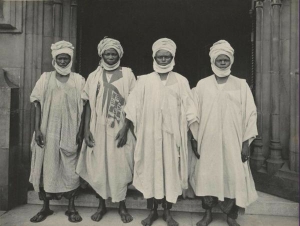
After Abu-Yazid passed away, his son Bawo succeeded him. Bawo had three sets of twins: Gobir and Daura, Katsina and Zazzau, and Kano and Rano. These six children were added to Abu-Yazid’s son from the Kanem wife, making them seven descendants of the Abu-Yazid marriage. Biram and his grandchildren are credited with creating the Hausa Bakwoi, or the seven states: Kano, Daura, Katsina, Gobir, Zazzau (Zaria), Rano, and Biram.
The seven sons that Abu-Yazid’s concubine bore were credited with founding the seven Hausa Banza Bakwoi (Bastard states). These are Ilorin (Yoruba), Nupe, Yauna, Kebbi, Zamfara, Gwari, and Jukun. The legend isn’t clear enough to be considered authentic and credible proof. The mythology, however, focuses more on the character of the connection with the central Sudanese kingdoms. Several factors cast doubt on this mythology, including:
The mythology clashes with a Gobir tradition that rules out any kind of kinship with Bawo.
The mythology suggests that Dauranama, a queen, presided over the city before Abu-Yazid’s arrival, indicating the existence of pre-existing states.
Furthermore, it would seem that the state of Gobir once lay further to the north, in the area of Azban. Other Hausa Bakwoi members did not force the state of Gobir to act until the late 15th century. Abdullah Smith’s idea regarding the founding of the Hausa state appears more organized and trustworthy, according to all signs.

The political structure was highly intricate. The king of the town and suburbs, known as Sarkin Kasar, was at the center of it all. The sarkin had several officials who assisted him in managing justice operations, with their privileges and rights restricting the king’s authority. These specialized officeholders included Mai Unguwa (the ward head), Sarkin Kofar (the gate guard), and Mago Jin-Gari (the town administrator). Sarkin Turuwa is the name given to the chief of several communities.
The Hausa political and social structure firmly established class division. The rulers and the talakawa (common people) were clearly distinguished from one another. Individuals of Talakawa descent could be promoted to officeholder positions if they rendered exceptional services.
some factors that led to the fall of these Hausa states.
Since the Hausa state could not unite and grow together, this meant that:
They turned into hunting grounds for extraterrestrials seeking treasure and fiefdom. Many Hausa states were subsequently subjugated by their strong neighbors. These Hausa states became rivalries as a result of their size, especially in the 15th century, when their boundaries began. The reason for these rivalries was a need for dominance and subjugation. As a result of distance and division, this hausa state could not unite to fight imperial powers such as Songhai, Tuareg, and Borno, who were constantly attacking this separated and distinct hausa land.
check out a brief history of the igbo people

Leave a Reply